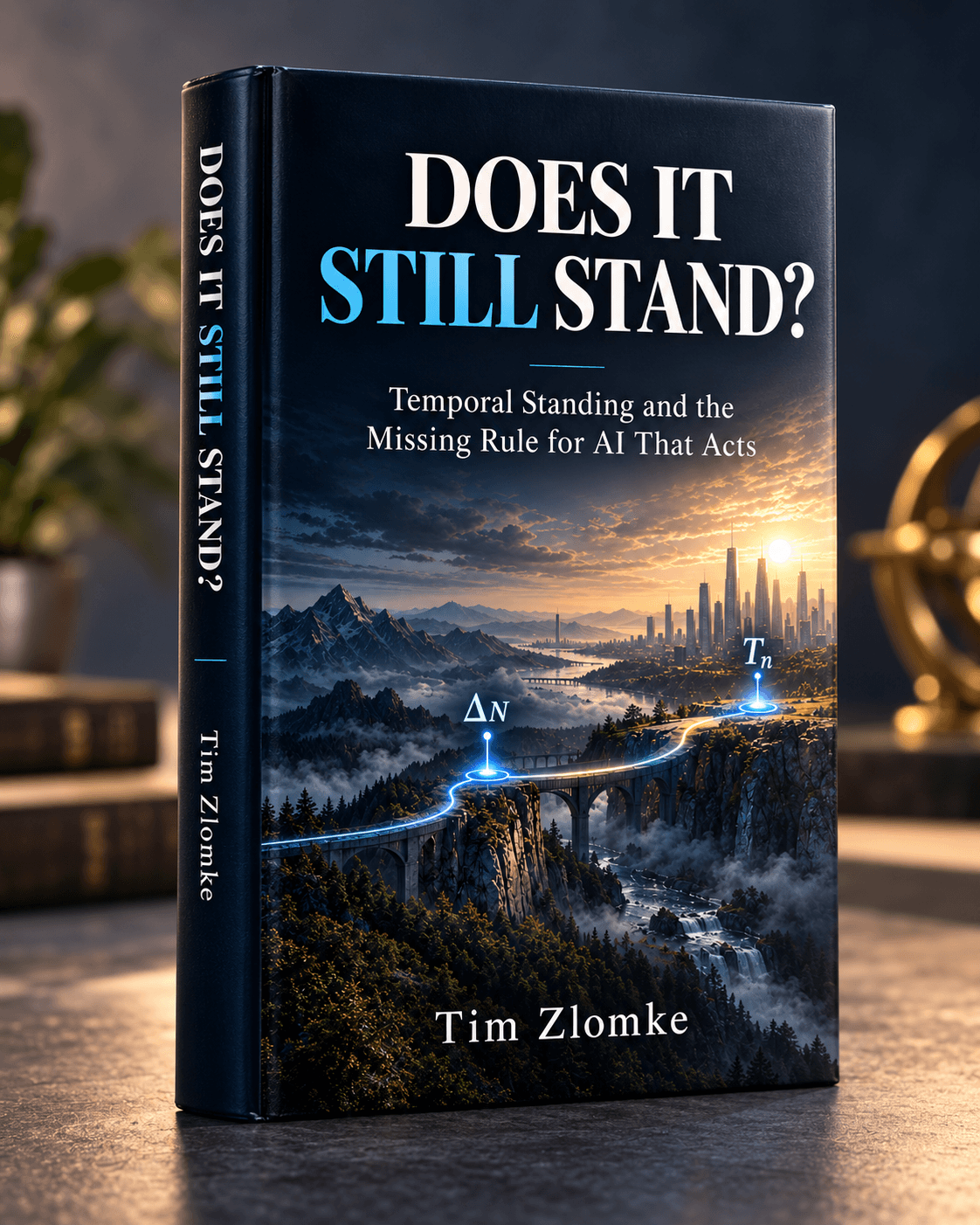
Does It Still Stand?
Temporal Standing and the Missing Rule for AI That Acts
Tim Zlomke
AI systems increasingly do more than answer questions. They notify, approve, deny, book, purchase, recommend, and act. But between the moment something is authorized and the moment a system creates a real-world consequence, reality can change.
Does It Still Stand? introduces Temporal Standing: a practical framework for determining whether the authority, evidence, consent, scope, and conditions behind an action still stand at the moment of consequence.
First Edition · PDF · Free to read and share from Moral Clarity AI
“This was authorized then. What has changed, and does it still stand now?”
The book moves from the broad problem of AI systems acting on stale information into the Temporal Standing framework: T₀ → ΔN → Tₙ. What stood then, what changed, and what legitimately stands now for this exact consequence?
Past authority is evidence of prior standing — not proof of present standing.
AI systems should re-evaluate authority, evidence, consent, and conditions before consequential action.
Standing may be preserved, defeated, or unresolved — and unresolved should not be silently converted into permission.
Temporal Standing is meant to be examined, challenged, implemented, and improved. Making the digital edition freely available lowers the barrier for builders, executives, researchers, and governance teams to inspect the framework directly.
Continue with the builder’s guide
Building Specialty Packs
Put the method into practice: declare competent sources, constitute scoped evidence, and examine the domain relationships Harmonic needs.
Explore the companion bookFree PDF download · No account required